
Last updated July 4, 2026
Garage Door Repair Maintenance Checklist for Pasadena Homeowners
The most expensive garage door call Mark White gets is almost never an emergency — it’s a homeowner who noticed a warning sign three months ago and assumed it would work itself out. A grinding noise, a door that hesitated on the way up, a spring that looked “a little rusty” — these aren’t mysteries. They’re a countdown. After 16 years doing this work in Pasadena, the pattern is clear: the $180 fix becomes a $600 fix the moment you delay it. This guide gives you a priority-ranked checklist built around that reality — not alphabetized busywork, but a sequence ordered by what’s about to cost you money versus what can wait.
Quick Answer
A complete garage door maintenance checklist for Pasadena homeowners covers monthly visual inspections, quarterly lubrication and hardware checks, and an annual full-system test — in that priority order. Pasadena’s temperature swings between cool winter mornings and summer days that push past 100°F in neighborhoods like Altadena and the foothills, which accelerates spring fatigue and degrades the wrong lubricants faster than homeowners expect. Catch the high-urgency items first; the cosmetic ones can wait.
Table of Contents
- Monthly Checks — The High-Stakes Tier
- How to Test Spring Tension Safely (Without Touching the Springs)
- What You’re Hearing: Rollers vs. Springs vs. Opener
- Quarterly Lubrication — The Right Products for Pasadena’s Heat
- Annual Full-System Inspection
- When Maintenance Becomes Repair Territory
- Common Mistakes to Avoid
- When to Call a Professional
- Frequently Asked Questions
- The Bottom Line
Monthly Checks — The High-Stakes Tier
These are the checks that, if skipped, produce the calls nobody wants to make on a Sunday morning. Do them once a month. They take under five minutes.
1. Visual Spring Inspection
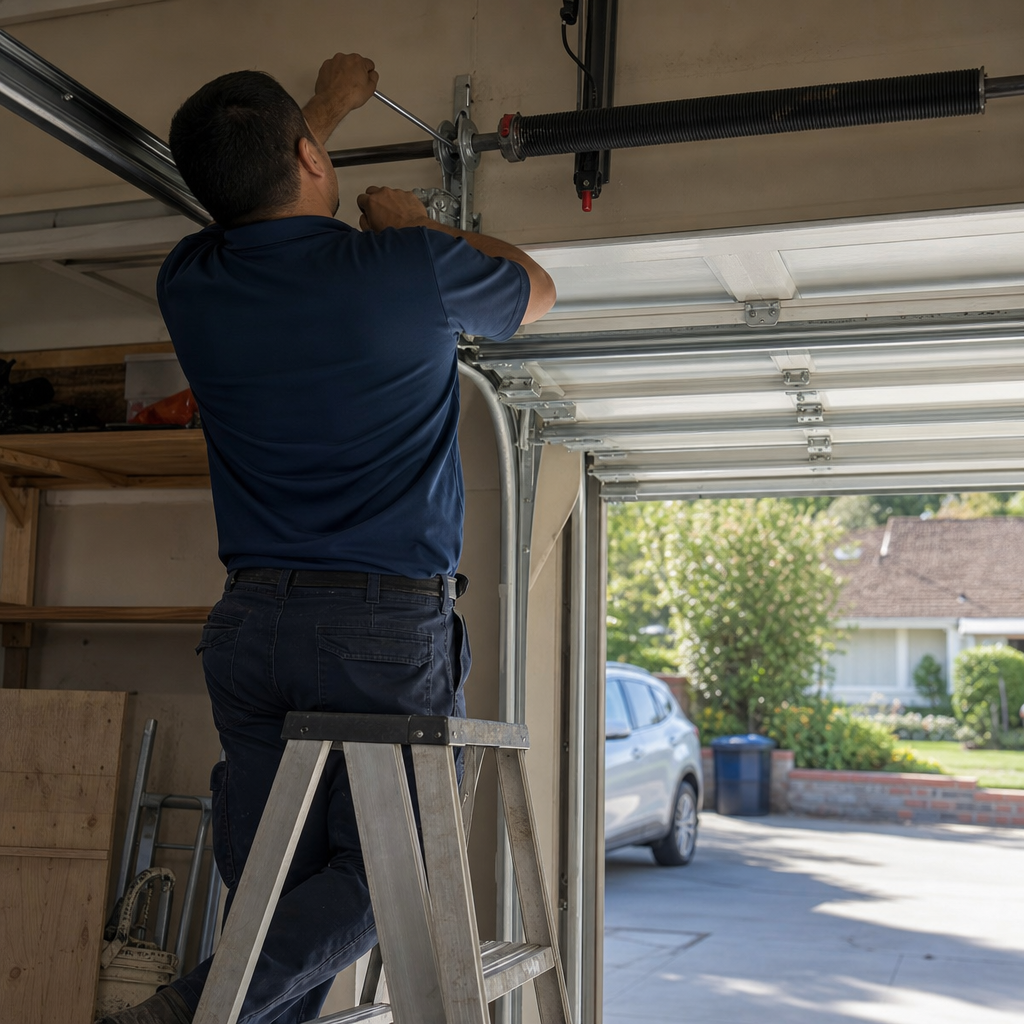
Stand inside your garage and look at the torsion spring (the horizontal bar above the door) or the extension springs (running alongside the horizontal tracks on each side). You’re looking for visible gaps in the coil, rust forming in sections, or any point where the spring looks bent or asymmetrical. A gap in a torsion spring means it has already partially broken and is operating on borrowed time. Do not operate the door. This is an immediate call-a-professional situation — a fully broken torsion spring under tension releases enough force to cause serious injury.
2. Balance Test
Disconnect your opener by pulling the red emergency release cord. Manually lift the door to waist height and let go. A properly balanced door stays put — it neither drifts up nor drops down. If it falls, the springs are losing tension. If it shoots upward, the springs are over-tensioned. Either condition puts excessive strain on your opener motor and your cables. In Pasadena’s warmer months, springs that passed this test in February may fail it by July because heat cycling accelerates metal fatigue.
3. Cable Inspection
Look at the lift cables running from the bottom corners of the door up to the drum at each end of the spring shaft. Fraying, kinking, or any visible strand separation means the cable is near failure. A snapped cable drops the door fast and unevenly. Don’t touch the cables — the tension on them is substantial — but looking costs nothing.
4. Reverse/Auto-Stop Safety Test
Place a 2×4 flat on the ground in the door’s path and close the door with the opener. A correctly functioning opener reverses automatically when it contacts the board. If it doesn’t, the auto-reverse sensitivity needs adjustment. This is a safety feature required under California code for all automatic operators, and a door that doesn’t reverse is a liability exposure in addition to a hazard.
How to Test Spring Tension Safely (Without Touching the Springs)
This is the one spring-related check a homeowner can do without tools and without touching anything under tension. Here’s the exact sequence:
- Disconnect the opener. Pull the red emergency release cord to put the door in manual mode.
- Close the door fully so it’s resting on the ground.
- Lift the door manually to about waist height — roughly 3 to 4 feet off the ground.
- Release it and step back. Don’t hold on. Let it do what it does naturally.
- Observe: A door that holds position within 6 inches of where you released it has acceptable spring tension. A door that drops more than 6 inches downward means the springs are underperforming. A door that rises on its own means over-tension.
- Reconnect the opener by pulling the release cord again or pressing the wall button — depending on your model (LiftMaster and Chamberlain units reconnect automatically on the next opener activation).
This test tells you spring condition without touching a single coil. If the door fails this test, that’s not a maintenance task anymore — that’s a repair that needs a trained technician. In our experience across Pasadena, over-tensioned springs are common on doors that were adjusted by a previous owner or a non-specialist handyman who estimated rather than measured.
What You’re Hearing: Rollers vs. Springs vs. Opener
Sound is one of the most reliable diagnostic tools available to a homeowner — if you know what you’re listening for. Here’s how to separate the signals:
Worn or Dry Rollers
A grinding or scraping sound that tracks with the door’s movement — louder when the door is moving, quieter when it stops — almost always points to roller wear or dry roller bearings. The sound is consistent and rhythmic, like something dragging across a surface. Steel rollers that have lost their nylon coating are the most common cause in older Pasadena homes. This is a maintenance-addressable problem. Lubrication may quiet it temporarily; replacement is the correct fix.
Failing Torsion Spring
A loud bang — often described as a gunshot or a heavy object falling in the garage — followed by a door that suddenly won’t open properly, is almost always a torsion spring break. Unlike rollers, a spring failure isn’t a gradual noise that gets louder over time. It’s sudden. If you heard something loud from the garage and now the door lifts crookedly or the opener strains visibly, stop using the door. The spring is broken.
Opener-Specific Sounds
A high-pitched whine or grinding coming from the opener unit itself — particularly on chain-drive Craftsman or older Genie models — points to worn drive gears or a dry chain. This is distinct from track noise because it originates from the ceiling-mounted unit, not the door. A clicking sound on activation that doesn’t result in door movement usually signals a stripped main drive gear, a common wear item on chain-drive openers after several years of daily use.
Popping or Creaking
A popping sound as the door moves, particularly in sections, suggests the panel hinges are binding or that a roller is catching at a bent track section. In Pasadena homes with attached garages, we see track misalignment caused by minor foundation settlement — not unusual in hillside neighborhoods like San Rafael Hills or areas near the Arroyo Seco.
Quarterly Lubrication — The Right Products for Pasadena’s Heat
Pasadena’s climate creates a specific lubrication problem that most general maintenance guides miss entirely. Summer temperatures in the San Gabriel Valley regularly exceed 95°F, and on east-facing garage walls in neighborhoods like Arcadia-adjacent east Pasadena, direct sun can push metal track temperatures even higher. Standard WD-40 is not a lubricant — it’s a solvent and a water displacer. Applied to springs or rollers in high heat, it thins out and migrates, leaving metal components effectively dry within weeks.
What to use:
- Springs: White lithium grease or a dedicated garage door spring lubricant. Apply sparingly — a light coat on the coils, not a drench. In summer, re-apply every 90 days rather than every six months because heat accelerates evaporation.
- Rollers (nylon, non-sealed): White lithium grease or silicone spray. Do not lubricate the rollers themselves — apply to the stem and the hinge pins.
- Rollers (steel, older): Same approach. If the rollers are rusted or visibly worn, lubrication is a temporary measure. Budget for replacement.
- Hinges: A light application of white lithium grease on the pivot points.
- Tracks: Do not lubricate the tracks. This is a common mistake. Lubricated tracks cause rollers to slip, not roll, which increases wear.
- Opener chain or belt: Chain-drive openers (common on Craftsman, older LiftMaster units) need light lubrication on the chain. Belt drives do not need lubrication. Screw-drive openers use a specific grease — check your model’s manual or ask when we’re on-site.
- Lock and weatherstripping: A silicone-based spray keeps the lock cylinder smooth and prevents the rubber bottom seal from cracking in heat.
What to avoid in temperatures above 90°F: WD-40, petroleum-based oils, and any product not rated for high-temperature applications. These products break down rapidly in Pasadena summers and can leave residue that attracts debris and accelerates wear.
Annual Full-System Inspection
Once a year, do a complete top-to-bottom review. If you’ve kept up with the monthly and quarterly tasks, this should surface only the slower-developing issues. Here’s the sequence:
- Inspect all hardware for tightness. Vibration from daily operation loosens bolts and lag screws over time. Use a socket wrench on the track brackets, roller brackets, and the spring anchor plate. Don’t overtighten — snug is correct.
- Check the bottom seal. The rubber weatherstripping along the bottom edge should make full contact with the ground across the entire width. Gaps let in water, pests, and the hot air that makes a Pasadena garage unusable in July. Replacement seals are inexpensive; a wet garage floor or a pest problem is not.
- Inspect the door panels for damage. Cracks, warping, or dents in the lower panels affect both weatherproofing and structural integrity. On steel doors from Clopay or Amarr, check for rust at the seams, particularly near the bottom where moisture collects. On Wayne Dalton composite doors, look for separation at the panel joints.
- Test the photo-eye sensors. Clean the lenses with a dry cloth. Misaligned sensors — the small units mounted near floor level on each side of the door frame — cause intermittent closing failures. Realign them so the indicator lights show solid (not blinking) on both units.
- Check opener force settings. Most modern LiftMaster, Chamberlain, and Raynor openers have adjustable up-force and down-force settings. If your door strains noticeably on the way up or slams on the way down, the force settings need calibration — not necessarily a hardware fix.
- Inspect the spring system for corrosion. Beyond the visible gap test you do monthly, an annual inspection should look at the full length of both torsion or extension springs for rust that has progressed beyond surface discoloration into pitting. Pitted springs are structurally compromised.
- Measure the gap at the sides and top. Weatherstripping on the sides and top should create a consistent seal. In older Pasadena homes, the door frame can shift seasonally — the San Gabriel Valley’s dry heat causes wood to contract and expand, and a gap that appeared in summer may have closed by January.
When Maintenance Becomes Repair Territory
This is the line most DIY guides don’t draw clearly enough, and it matters for both safety and liability.
Homeowners can safely do: visual inspections, the balance test, lubrication, tightening hardware (not spring hardware), cleaning sensors, replacing the bottom seal, and testing the auto-reverse function.
Homeowners should not attempt: spring replacement or adjustment of any kind, cable replacement or reattachment, track realignment on a door under spring tension, opener force adjustment beyond what the user manual covers, or any repair that requires releasing stored spring tension.
Here’s why this line matters in practical terms: torsion springs store a significant amount of energy — enough to cause serious injury if released unexpectedly. The winding rods and procedures used to adjust torsion spring tension are not intuitive, and an incorrect adjustment doesn’t always fail immediately. We’ve seen doors in Pasadena that were adjusted incorrectly and ran fine for three weeks before the spring let go. The homeowner had no idea the repair was faulty.
California doesn’t require a specific license for garage door repair work, but work done improperly that results in property damage or injury carries liability exposure for whoever performed it. When a task requires releasing spring tension, that’s professional territory — not because of regulation, but because the consequences of getting it wrong are severe.
If you’re unsure which side of the line a task falls on, that uncertainty itself is the answer. Call before you proceed. For anything covered under the Garage Door Repair in Pasadena service, Mark handles the diagnosis and gives you a straight answer about what it actually needs.
Common Mistakes to Avoid
- Using WD-40 as a lubricant on springs or rollers. WD-40 displaces water and loosens rust, but it evaporates quickly and leaves components dry — particularly at Pasadena’s summer temperatures. Use white lithium grease or a dedicated garage door lubricant instead.
- Lubricating the tracks. Tracks should be clean and dry. Greased tracks reduce the friction rollers need to maintain contact, causing slippage, uneven movement, and accelerated roller wear. Wipe tracks down with a dry cloth; don’t spray them.
- Ignoring a door that’s “a little off balance.” In our experience across Pasadena, a door that doesn’t hold position at waist height is already putting 30–40% more strain on the opener motor every cycle. That $150 spring adjustment avoided today tends to arrive as a $400 opener replacement in six months.
- Tightening the spring anchor plate bolts yourself. The central anchor plate — the bracket the torsion spring winds around — is under load. Tightening its mounting hardware while the spring is wound is dangerous. This is one of the hardware items to leave for a professional visit.
- Skipping the balance test after a spring replacement. If you’ve had springs replaced recently — by anyone — run the balance test within 30 days. Springs are set to a specific tension based on your door’s weight, and a miscalibration that isn’t caught early compounds into opener strain and premature cable wear.
- Assuming a slow door is just an aging opener. A door that moves slowly or strains upward is more often a spring tension problem than an opener problem. Replacing an opener on a door with degraded springs wastes money and puts the new motor under the same excessive load that wore out the first one.
- Letting rust on extension springs go unchecked in Pasadena’s dry season. The San Gabriel Valley’s extended dry periods cause surface rust to advance faster than in coastal climates because there’s no seasonal moisture to slow the oxidation process. Surface rust on extension springs that looks minor in November can be structural by March.
When to Call a Professional
Call a professional immediately if: the door won’t open or close at all, you heard a loud bang followed by abnormal door behavior, the door is visibly crooked or hanging from one side, a cable has snapped or come off the drum, or any spring shows a visible gap or asymmetry. These aren’t items to troubleshoot incrementally — they’re situations where continued operation risks injury or makes the eventual repair more expensive.
Schedule a professional visit (non-emergency) when: the balance test fails, the door passes the reverse test only barely, rollers are making consistent noise despite lubrication, or you’re more than two years out from your last professional inspection.
If you need a Garage Door Opener in Pasadena assessed or replaced alongside any of the above, Mark can evaluate the full system in one visit rather than treating components in isolation.
Apex Garage Door Repair Pasadena offers free estimates across Pasadena — call (747) 307-6899 and Mark will give you a straight answer on what you’re dealing with before any work begins.
Frequently Asked Questions
How often should I lubricate my garage door in Pasadena?
Lubricate springs, hinges, and roller stems every three months in Pasadena — not every six months as most national guides suggest. The San Gabriel Valley’s summer heat accelerates lubricant breakdown on metal components, particularly on east- and south-facing garages that absorb direct sun. Use white lithium grease or a high-temperature silicone lubricant; avoid petroleum-based products above 90°F. Call (747) 307-6899 if you want a product recommendation specific to your door type.
What does a broken torsion spring sound like?
A broken torsion spring sounds like a loud bang — often described as a gunshot or a heavy object falling. It’s sudden, not gradual. After the sound, the door will either not open at all or will open crookedly with the opener straining visibly. If this describes what you experienced, stop using the door and call a professional. Operating a door with a broken spring causes cable and drum damage that adds to the repair cost.
Can I replace garage door springs myself in Pasadena?
No — and not because of any Pasadena-specific regulation. Torsion springs store substantial mechanical energy and require specific winding tools, precise tension calibration based on the door’s exact weight, and training to handle safely. An incorrect installation doesn’t always fail visibly at first, which makes DIY spring work particularly dangerous. Mark White has replaced springs on every major brand — LiftMaster, Clopay, Amarr, Wayne Dalton, and others — and can typically complete the work same-day. Call (747) 307-6899 for a free estimate before attempting this yourself.
How do I know if my garage door opener needs replacing or just repairing?
If the opener motor runs but the door doesn’t move, the problem is most likely a stripped main drive gear — a repair that costs a fraction of a full replacement. If the motor doesn’t activate at all, start with the safety sensors and the power supply before assuming the motor is failed. Full replacement makes sense when the unit is more than 12–15 years old, lacks modern safety features, or has already had multiple drive-gear replacements. If you’re unsure, Mark can diagnose the opener during a free estimate visit and tell you exactly which scenario you’re in. Consider Garage Door Installation in Pasadena options if a full system upgrade makes more financial sense than continued repair.
What’s the typical cost of garage door maintenance in Pasadena?
A professional maintenance tune-up in Pasadena — covering lubrication, hardware tightening, balance adjustment, and sensor alignment — typically runs $80–$150. Spring replacement ranges from $180–$340 depending on spring type (torsion vs. extension) and door weight. Roller replacement runs $90–$180 for a full set. Cable replacement is typically $120–$200. These are Pasadena-market ranges based on current service pricing — call (747) 307-6899 for an exact quote on your specific door and situation.
How do I test whether my garage door is balanced correctly?
Disconnect the opener by pulling the red emergency release cord. Manually lift the door to waist height — approximately 3 to 4 feet — and release it. A balanced door stays within 6 inches of where you let go. A door that drops to the floor or rises toward the ceiling has a spring tension problem. This test is safe for homeowners to perform because it doesn’t involve touching any spring hardware. If the door fails the test, that’s a job for a professional — don’t attempt to adjust the spring tension yourself.
The Bottom Line
Garage door maintenance in Pasadena isn’t complicated, but it has to be sequenced correctly. Monthly spring and cable checks catch the failures that cost $400+ before they happen. Quarterly lubrication with the right products — not WD-40, not anything that degrades above 90°F — keeps hardware running smoothly through the San Gabriel Valley’s long summers. An annual full-system inspection finds the slow-developing issues before they become the loud bang on a Sunday morning. Know the audio cues, run the balance test, and recognize where the DIY line ends. Everything on the repair side of that line is faster and safer with 16 years of pattern recognition behind it.
- Monthly: visual spring check, balance test, cable inspection, auto-reverse test
- Quarterly: full lubrication with high-temp appropriate products, hardware snug-check
- Annually: complete system audit — panels, seals, sensors, force settings, hardware
- Never: DIY spring adjustment, cable reattachment, or any task requiring tension release
- Always: run the balance test after any spring-related service, whether you did it or someone else did
If anything on this checklist turns up a problem — or if you’d rather have Mark run through the full inspection himself — call (747) 307-6899. Estimates are free, the diagnosis is honest, and 1,222 five-star reviews in Pasadena suggest the outcome is predictable in the best possible way.
Written by Mark White, Owner & Lead Technician at Apex Garage Door Repair Pasadena, serving Pasadena since 2010.